
Answer Engine Optimization (AEO): How to Get Cited by AI
How AI answer engines choose sources, and the content, technical and measurement steps that make your pages the ones they cite.
Read article
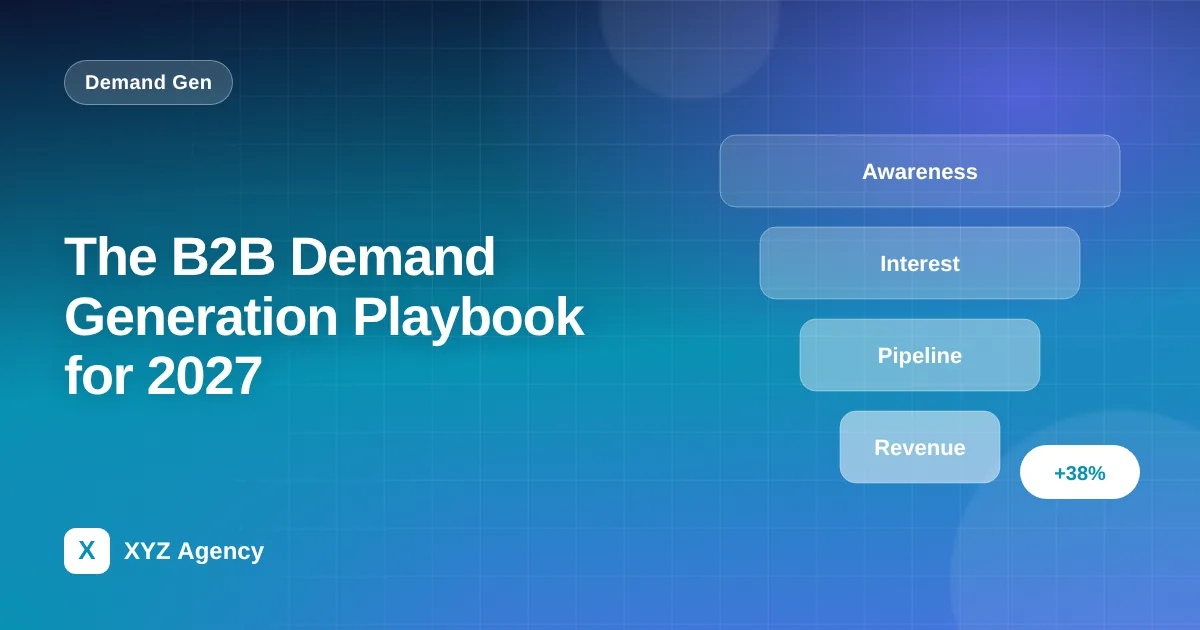
B2B demand generation creates awareness and preference among buyers before they are ready to talk to sales, while lead generation captures those already in market. A 2027 playbook has five parts: a sharp ideal customer profile, a consistent content engine, high-intent paid capture, fast conversion paths, and measurement tied to qualified pipeline and revenue in the CRM.
B2B demand generation is the set of programs that create awareness of a problem and preference for your solution before a buyer ever fills out a form. Lead generation captures people who are already looking; demand generation creates the reason to look in the first place. Heading into 2027, a healthy pipeline needs both, built as one connected system.
This playbook covers the five parts of that system: your ideal customer profile, a content engine, intent capture, conversion paths and revenue measurement. Each section includes the decisions to make and the checks we run.
Demand generation builds future buyers by educating and earning trust with people who are not yet in market. Lead generation converts people who are in market into contacts and meetings your sales team can work.
| Dimension | Demand generation | Lead generation |
|---|---|---|
| Goal | Create awareness and preference | Capture contacts and meetings |
| Audience | Whole ideal customer profile, mostly out of market | Buyers actively researching now |
| Typical tactics | Ungated content, video, social, podcasts, events | Search ads, gated offers, demo requests, retargeting |
| Primary metrics | Engaged accounts, branded search, self-reported attribution | Qualified pipeline, cost per opportunity, win rate |
| Time horizon | Months to quarters | Days to weeks |
Teams that only run lead gen fight over the same small pool of in-market buyers and watch costs climb. Teams that only run demand gen build an audience but struggle to show revenue. The playbook below connects the two.
Buyers now do most of their research alone, often with AI assistants, and involve sales later. Gartner's March 2026 sales survey of 646 B2B buyers found that 67% prefer a rep-free experience and 45% used AI during a recent purchase.
Sellers still matter. A separate Gartner survey released in May 2026 found that 69% of B2B buyers prefer to check AI-generated insights with a sales rep, and that buyers used an average of seven information sources in a recent purchase. Your content has to be present in those self-directed moments, and your team has to be ready when the buyer raises a hand.
Start with the customers who close fastest, pay the most and stay the longest, then describe what those companies and roles have in common. Every later decision, from keywords to audiences to content topics, should map back to this profile.
Revisit the profile at least twice a year. Markets shift, and a profile built on old wins quietly steers spend toward the wrong accounts.
Pick three to five themes your buyers care about and publish consistently around them in the formats they actually consume. Consistency beats volume, because trust compounds when the same buyers see useful ideas from you week after week.
Short-form video and social platforms now shape how buyers discover vendors, a shift we cover in social search and short-form video. Repurpose deliberately: one strong idea should become ten assets, not ten unrelated ideas.
Demand generation is a system. The teams that win treat it like one.
Pair the content engine with high-intent paid search, retargeting and a conversion path that lets a ready buyer book a meeting in under a minute. Demand creation fills the top of the funnel; intent capture makes sure you are present when someone is ready.
Landing pages make or break this step: match the message to the ad, keep one primary action, keep forms short and make the page load fast on mobile.
Measure qualified pipeline and revenue, not form fills. Connect ad platforms and your website to the CRM so you can see which programs create opportunities that close.
Feed closed-won outcomes back to ad platforms so their bidding optimizes toward revenue instead of cheap form fills. Google's enhanced conversions for leads, an upgraded form of offline conversion import, matches hashed lead data from your CRM back to ad interactions. For a model leadership will believe, read attribution your CFO will actually trust.
Advotis Agency builds demand generation programs that connect content, paid media and CRM reporting into one system. Explore our content and social services or contact our team to plan your 2027 pipeline engine.
B2B demand generation is the set of marketing programs that build awareness of a problem and preference for your solution among buyers who are not yet in market. It includes content, social, video, events and thought leadership. Its goal is a larger pool of future buyers who already trust you when they start evaluating vendors.
Leading indicators such as engagement from target accounts and growth in branded search usually move first. Pipeline impact typically follows over one or more sales cycles, so a business with a six-month cycle should expect to wait longer than one with a six-week cycle. Judge progress quarterly, not weekly.
There is no universal ratio. Most teams start by fully funding capture of existing in-market demand, such as high-intent search, then grow investment in creation as they prove that engaged audiences convert. Revisit the split each quarter using pipeline data from the CRM.
Gating still works for high-value assets aimed at buyers close to a decision, such as benchmarks, assessments or detailed templates. For awareness content, ungated distribution usually reaches more of your ideal customer profile and builds trust faster. Many teams publish ungated and offer an optional download or follow-up.

Written and reviewed by the Strategy Team at Advotis Agency — specialists who build and grow websites, apps and AI products for clients every day. About us
How AI answer engines choose sources, and the content, technical and measurement steps that make your pages the ones they cite.
Read article
Twelve proven ways companies use AI agents in 2026, how to choose your first one, and how much autonomy to give it.
Read article
How to measure, diagnose and fix Interaction to Next Paint so your site feels instant and passes Core Web Vitals.
Read articleTalk to a senior specialist — we reply within one business day with a clear plan.